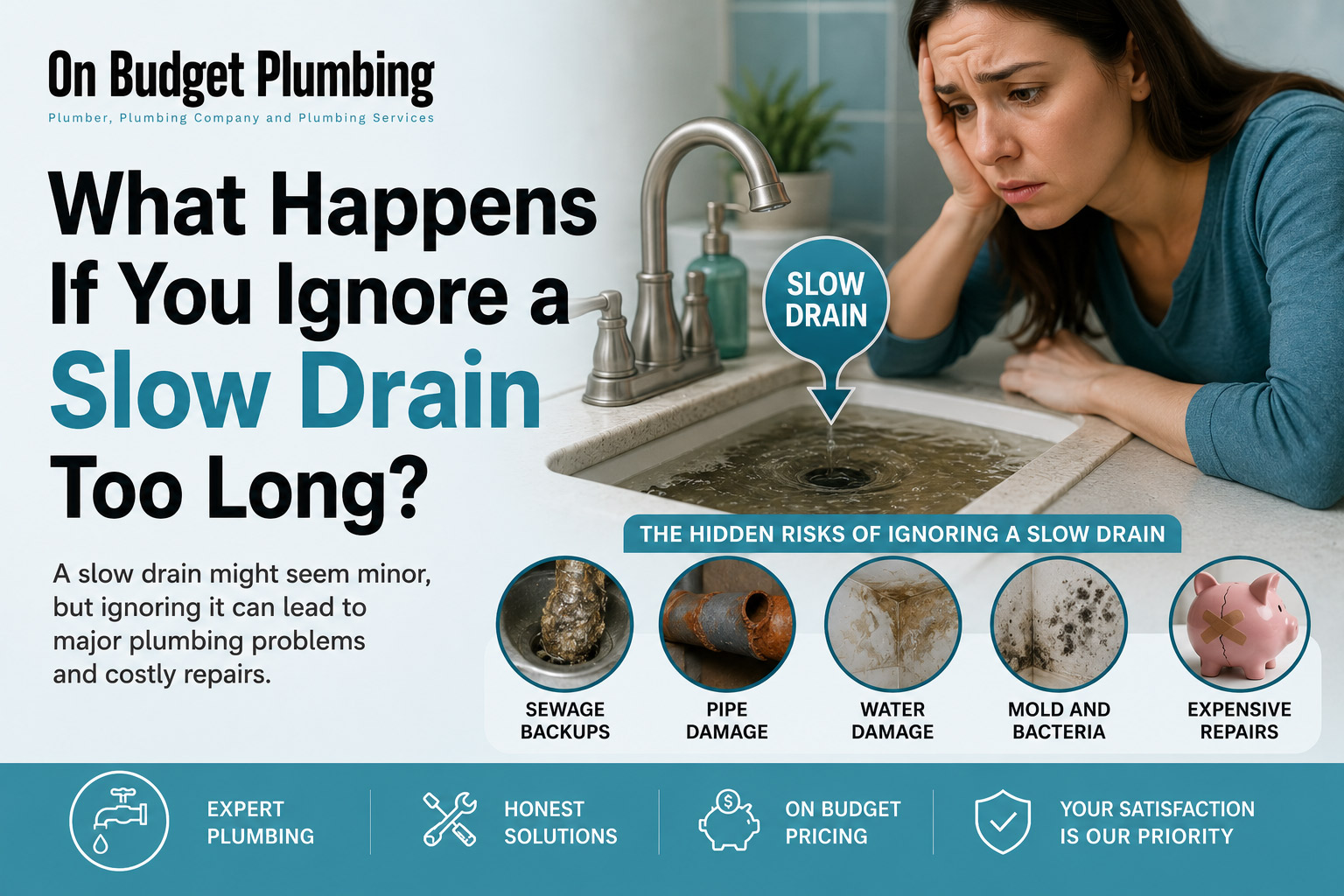
What Happens If You Ignore a Slow Drain Too Long?
A slow drain feels like a minor inconvenience — something to deal with when there is time. The water still goes down eventually. The sink still works. Life carries on. But a slow drain is not a stable condition. It is a worsening one. What starts as a fixture that drains in 30 seconds instead of 10 will, without intervention, become a fixture that does not drain at all — and may take the surrounding plumbing system with it. Understanding what actually happens inside a drain as a blockage develops changes the way most homeowners think about waiting it out.
How a Slow Drain Becomes a Full Blockage
Drain blockages build in layers. The first layer is typically a thin coating of soap scum, grease, or hair that catches on a rough pipe surface or partial obstruction. That layer then catches more material passing through. Over time, what started as a coating becomes a partial obstruction, and the partial obstruction becomes a near-complete one. The process looks like this:
A thin residue layer forms, often around the stopper or trap.
Debris accumulates on top of the residue, narrowing the pipe diameter.
Flow velocity slows further, allowing heavier material to settle rather than pass through.
Organic matter trapped in the buildup begins to decompose, producing gases and attracting bacteria.
The weight and composition of the blockage becomes dense enough to resist flushing with water.
A full blockage forms, and pressure begins to back up into connected fixtures.
At no point in that process does the problem pause. It always moves toward a worse state unless something removes it.
Secondary Damage That Goes Beyond the Drain
The direct consequence of a slow drain is obvious — it stops draining. But the secondary consequences are what make ignoring one genuinely costly. In Edmonton, Alberta, where homes often have older drain infrastructure and basement floor drains connected to the same main line, a partial blockage in one area can create pressure problems throughout the system.
Sewage odors — Decomposing organic matter and bacterial activity inside a slow drain produces hydrogen sulfide gas, which enters the home through the fixture opening. This is both unpleasant and, in concentrated forms, a health concern.
Pipe damage from chemical cleaners — Many homeowners reach for drain cleaning products when a drain slows. These chemicals are corrosive and can damage older pipes, particularly cast iron or galvanized steel, accelerating deterioration over time.
Backup into connected fixtures — In a shared drain line, a severe blockage can cause wastewater to back up into other fixtures on the same branch. A clogged bathroom sink can begin to affect the tub, or a clogged kitchen drain can affect a nearby laundry basin.
Main line backup — If the blockage is on or near the main sewer line rather than a branch line, a full backup can affect every drain in the home simultaneously. This is a significant emergency requiring immediate attention.
Water damage from overflow — If a fully blocked fixture overflows during normal use, the water that spills onto floors, cabinetry, or into wall cavities can cause structural and finish damage that far exceeds the cost of drain cleaning.
Why Edmonton, Alberta Homes Face Specific Drain Risks
Drain systems in Edmonton, Alberta face environmental stressors that homeowners in milder climates simply do not encounter. Clay-heavy soil shifts with freeze-thaw cycles, which creates ground movement around buried sewer lines. Over years, this movement can cause pipe joints to separate, create low spots where waste pools, or allow roots from nearby trees to push through stressed connections. A slow drain that appears to be an internal buildup issue may actually have an external structural cause underground — something no amount of store-bought drain cleaner will address. A camera inspection is the only way to know for certain what is happening in a buried line.
When a Slow Drain Needs Professional Attention
Not every slow drain requires a service call on day one. But several indicators signal that the problem has gone beyond what a homeowner can address effectively on their own. A plumber should be called when the slow drain has not improved after basic cleaning attempts, when multiple fixtures are slow at the same time, when there are gurgling sounds from drains or toilets when other fixtures are used, when sewage odors are present, or when there has been a prior history of main line backups in the home. Each of these points to a systemic issue rather than a surface-level one.
Frequently Asked Questions
Are enzyme-based drain treatments effective for slow drains?
Enzyme cleaners can help break down organic material like grease, hair, and soap scum when used consistently as a maintenance measure. They are not effective for significant or dense blockages, and they do not address structural issues like root intrusion or pipe deformation.
Can a slow drain affect water pressure at nearby fixtures?
A slow drain does not directly affect water pressure. However, if a drain issue causes backpressure or air entrainment in the line, it can affect how smoothly water flows from connected fixtures. The two systems are separate, but severe blockages can cause unexpected effects across plumbing branches.
How often should drain lines be cleaned as preventive maintenance?
For a typical household, professional drain cleaning every 18 to 24 months is a reasonable maintenance schedule. Homes with older pipes, mature trees nearby, high cooking grease output, or a prior history of backups benefit from annual cleaning.
Will homeowner's insurance cover a sewer backup caused by a slow drain?
Standard homeowner's insurance policies typically do not cover sewer or drain backup unless a specific endorsement has been added. Check your policy and consider adding that coverage if your home has older drain infrastructure or a history of drainage issues.
Can a slow drain in one bathroom indicate a problem with the main sewer line?
Yes. If a drain on the lowest level of the home or one connected directly to the main line is slow, it can signal a main line obstruction. The main line serves every fixture in the home, so issues there affect the entire system rather than just one area.
Conclusion
A slow drain is not a plumbing problem that waits patiently for you to get around to it. It builds toward a worse outcome on its own timeline. The earlier it is addressed, the simpler and less expensive the solution tends to be. On Budget Plumbing serves homeowners across Edmonton, Alberta with professional drain cleaning, camera inspections, and honest diagnostics that identify whether the problem is in the fixture, the line, or something deeper underground. Do not wait until the backup happens to make the call.
