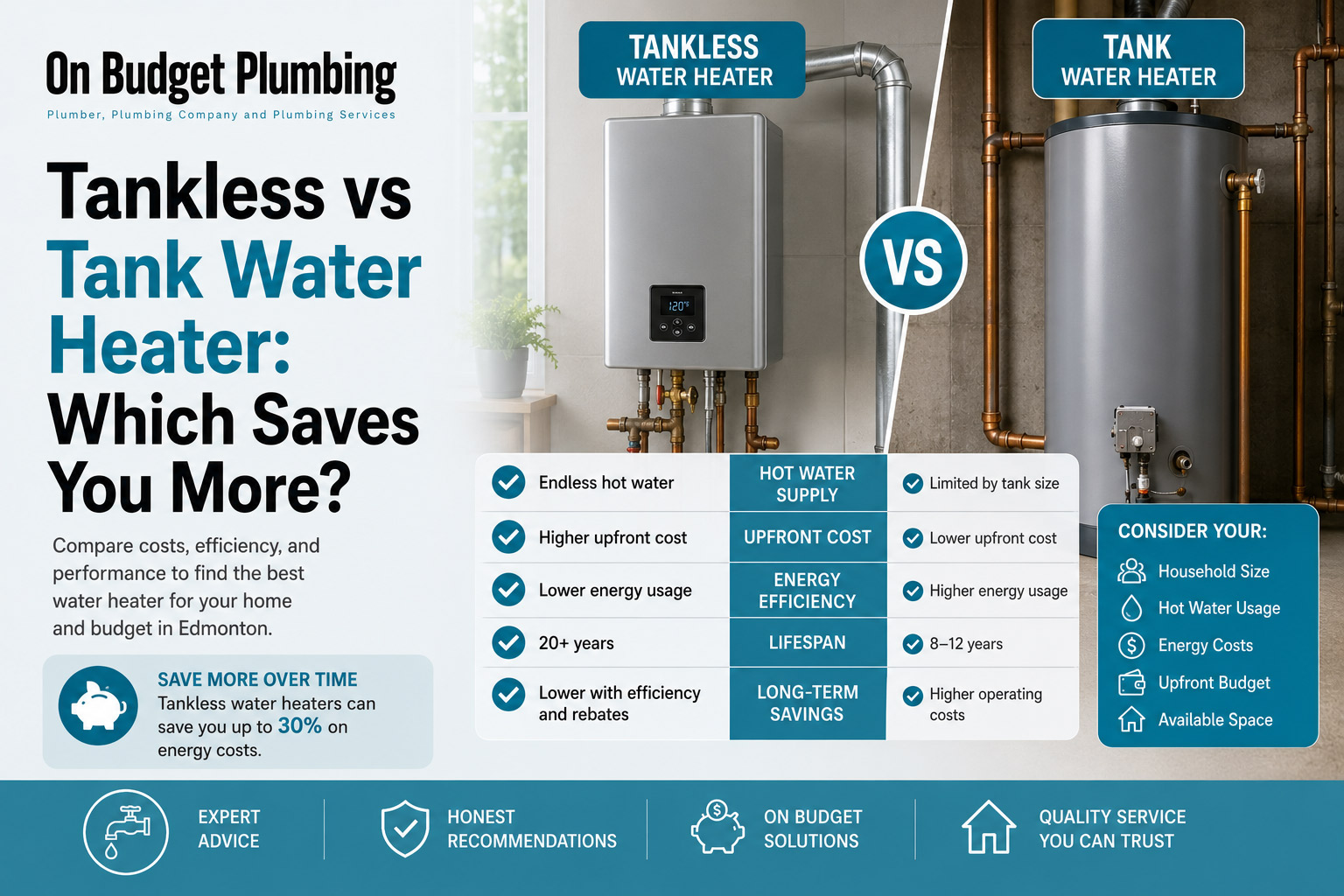
Tankless vs Tank Water Heater: Which Saves You More?
When a water heater reaches the end of its life — or when a homeowner simply wants to upgrade — the tankless versus tank question comes up almost immediately. Both systems heat water. Both are widely available and serviceable in Edmonton, Alberta. But they work differently, cost differently, and perform differently depending on how a household actually uses hot water. The right answer is not the same for everyone, and the decision deserves more than a quick look at the upfront price tag.
How Each System Actually Works
Understanding the mechanical difference helps explain why the performance, cost, and longevity profiles are so different between the two types.
A tank water heater stores a set volume of water — typically 150 to 270 litres in a residential unit — and keeps it heated continuously. The burner or element cycles on and off to maintain temperature regardless of whether hot water is being used. This means energy is consumed around the clock, including through the night and during times when the home is empty.
A tankless water heater has no storage. Cold water flows through the unit on demand, and a high-powered burner or electric element heats it instantly as it passes through. When no hot water is being drawn, the unit does nothing and consumes no energy.
The Full Cost Comparison
The table below compares the two systems across the factors that matter most to homeowners in Edmonton, Alberta making a long-term decision.
Where Tankless Systems Genuinely Save Money in Edmonton, Alberta
The energy efficiency advantage of a tankless system is real, but it is most significant in specific situations. In Edmonton, Alberta, where natural gas prices fluctuate and heating season places additional load on household systems, the standby heat loss from a tank system is not trivial. A tank that runs 24 hours a day, including through a cold Alberta winter when the utility room temperature drops significantly, works harder than one in a mild climate.
Households where tankless delivers the strongest financial case include smaller households of one to three people with moderate hot water demand, homes where the water heater is located in an unheated or poorly insulated space, properties where the occupants are away for extended periods, and homes where a long-term owner plans to be there for the full lifespan of the unit — capturing the full energy savings window.
Where a Tank System Still Makes Sense
A traditional tank system is not the wrong choice in every situation. There are scenarios where it is clearly the better fit, and pretending otherwise does not serve homeowners well. A tank system is often the right call for larger families with high simultaneous hot water demand — particularly where multiple showers, a dishwasher, and laundry may all run within the same window. A tankless unit with a modest flow rate may struggle to serve all demands simultaneously without a drop in temperature. Additionally, homes where the existing gas line or electrical supply cannot support a tankless unit without expensive upgrades may find that the infrastructure cost eliminates the financial advantage entirely. In those cases, a high-efficiency tank unit may deliver a better total value.
Frequently Asked Questions
Can a tankless water heater handle simultaneous hot water demands in a large household?
It depends on the unit's flow rate rating. High-capacity tankless units can serve multiple simultaneous draws, but they cost more and may require gas line upgrades. For very large households with high peak demand, a dual tankless setup or a high-capacity tank unit may be more practical.
Does a tankless water heater work well with hard water?
Tankless units are more sensitive to mineral scale than tank systems because the heat exchanger has a smaller surface area and tighter passages. In areas with harder water, a water softener or regular descaling is more important for tankless units than for tank systems.
How long does it take to break even on a tankless water heater investment?
It depends on energy costs, household usage, and the cost difference between units. In many cases, the break-even point falls somewhere between 5 and 10 years. Homeowners planning to sell within a few years may not recoup the investment through energy savings, though the unit itself adds value.
Are there rebates available for tankless water heaters in Alberta?
Provincial and utility-based energy efficiency programs do periodically offer rebates for high-efficiency appliances including tankless water heaters. Availability changes, so confirm current incentives with your plumber or utility provider before purchase.
Can a tankless water heater be installed where a tank unit currently is?
Sometimes, but not always. Tankless units have different venting requirements, may need a larger gas supply line, and require condensate drainage in high-efficiency models. A licensed plumber should assess the existing setup before assuming a direct swap is possible.
Conclusion
The tankless versus tank question does not have a universal answer. Both systems work well when matched to the right household and installed correctly. The best decision comes from an honest assessment of your hot water usage, your home's existing infrastructure, your budget, and how long you plan to stay in the property. On Budget Plumbing helps homeowners throughout Edmonton, Alberta work through exactly this decision — with a clear-eyed look at both options and no push toward the more expensive one. Reach out for a consultation before making a final call.
